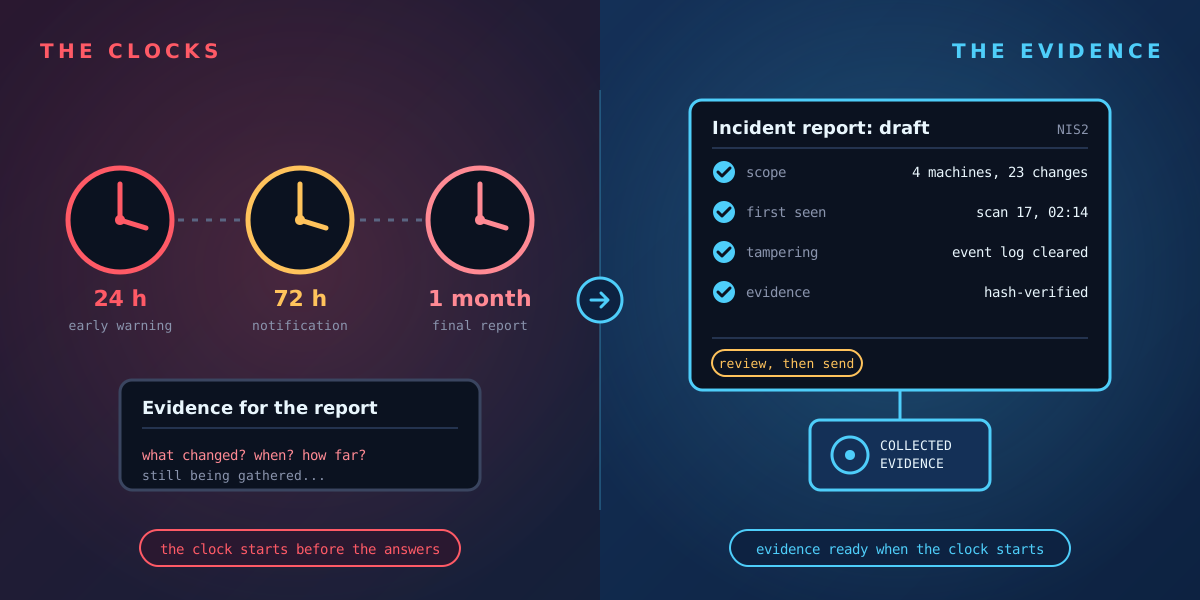
| European Union | NIS2 Directive | In force | Essential and important entities in 18 sectors, in every EU member state | 24 h early warning, 72 h notification, final report within 1 month |
| United Kingdom | NIS Regulations 2018 | In force | Operators of essential services (energy, transport, health, water, digital infrastructure) and digital service providers | 72 h to the competent authority |
| United Kingdom | Cyber Security and Resilience Bill | In Parliament | Replaces and expands NIS: adds managed service providers, data centres and critical suppliers | Proposed 24 h initial notification to the regulator and the NCSC, then a full report within 72 h |
| Switzerland | Information Security Act | In force (April 2025) | Critical infrastructure operators, including energy, water, transport and public administrations | 24 h to the National Cyber Security Centre, then complete the report within 14 days |
| United States | CIRCIA (Cyber Incident Reporting for Critical Infrastructure Act) | Law; final rule under White House review | Covered critical infrastructure organisations across 16 sectors | 72 h for covered cyber incidents and 24 h for ransom payments, to CISA |
| United States | TSA Security Directives | In force | Pipelines, freight and passenger rail, and aviation | 24 h to CISA |
| United States | NERC CIP-008 | In force | Owners and operators of the bulk electricity grid | 1 h for reportable incidents; attempted compromises by the end of the next calendar day, to E-ISAC and CISA |
| United States | DFARS 252.204-7012 | In force | Defence contractors handling controlled defence information | 72 h to the Department of Defense (DC3) |
| Canada | Critical Cyber Systems Protection Act (Bill C-8) | Law since June 2026, not yet in force | Designated operators in telecoms, energy, banking, transport and nuclear | Within a period set by regulation, no more than 72 h, to the Communications Security Establishment |
| Brazil | Cybersecurity Legal Framework (Bill 4752/2025) | Proposed | Critical infrastructure and essential services | Mandatory incident reporting proposed; deadlines not yet set |
| Australia | Security of Critical Infrastructure (SOCI) Act | In force | Critical infrastructure assets in 11 sectors | 12 h for incidents with a significant impact; 72 h for other relevant impact, to the Australian Signals Directorate |
| Australia | Cyber Security Act 2024 | In force (May 2025) | Businesses with turnover above A$3M, and all critical infrastructure | Ransomware or extortion payments within 72 h of paying |
| Singapore | Cybersecurity Act (amended 2024) | In force (amendments Oct 2025) | Owners of critical information infrastructure | 2 h initial notification to the Cyber Security Agency, then a detailed report within 14 days |
| India | CERT-In Directions 2022 | In force | Almost all organisations: service providers, data centres, companies and government bodies | 6 h to CERT-In |
| China | National Cybersecurity Incident Reporting Measures | In force (Nov 2025) | All network operators, stricter for critical information infrastructure | 4 h for reportable incidents; 1 h where critical information infrastructure is involved |
| Japan | Active Cyber Defence Act | In force (Oct 2026) | 258 critical infrastructure operators in 15 sectors | Preliminary report as soon as possible for DDoS, within 3–5 days for ransomware and other attacks; detailed report within 30 days |
| South Korea | Information and Communications Network Act (amended) | In force (Aug 2024) | Information and communications service providers | 24 h to the Ministry of Science and ICT or KISA, with updates within 24 h of confirming new details |
| New Zealand | Critical infrastructure cyber security regime | Proposed | Critical infrastructure entities | Proposed 24 h early warning, then a full report within 72 h |
| Saudi Arabia | NCA cybersecurity controls (ECC, and NCNICC for the private sector) | In force | Government bodies, critical national infrastructure and, increasingly, private-sector companies | Incidents reported to the National Cybersecurity Authority, within the timeframes set in NCA requirements |
| South Africa | Cybercrimes Act, section 54 | Law, reporting duty not yet in force | Electronic communications service providers and financial institutions | Where feasible within 72 h, to the South African Police Service |