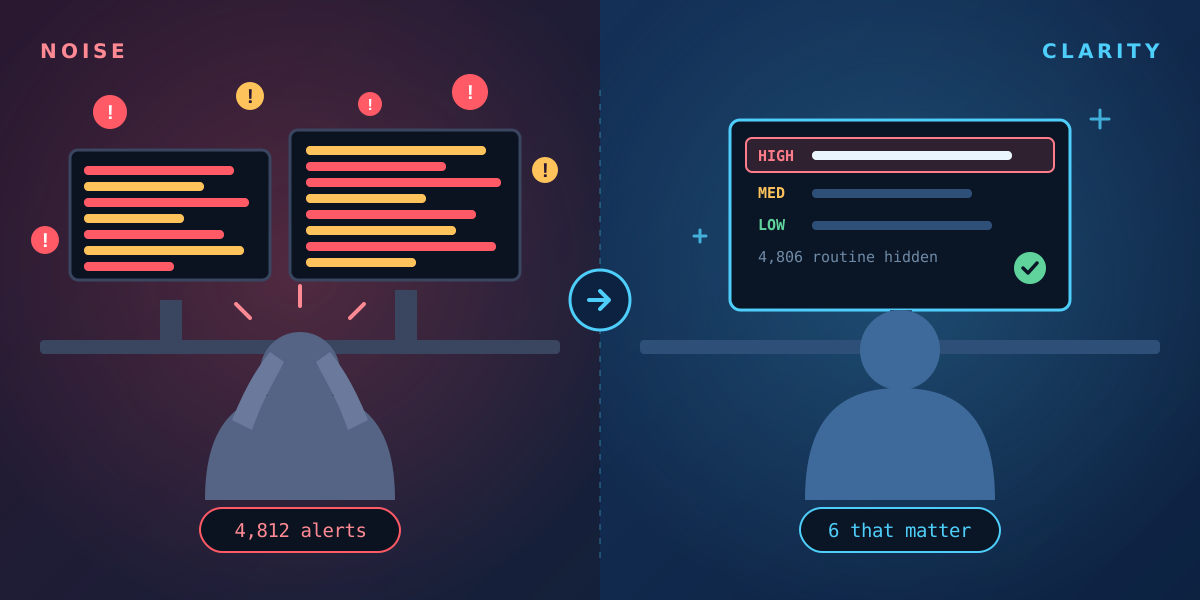
Every security team knows the feeling. The queue never empties, most alerts turn out to be nothing, and by the end of a shift every new one looks like the last hundred. That is alert fatigue. It is not just an annoyance: it is one of the main reasons real attacks get missed, and one of the main reasons good analysts leave.
False positives and false negatives
Two kinds of mistake matter in detection:
- A false positive is an alert about something harmless: a backup job that looks like data theft, an admin script that looks like an attack.
- A false negative is a real attack that raises no alert at all, or whose alert is dismissed.
It is tempting to treat these as opposites, where tuning down one raises the other. In practice they are linked through people. A flood of false positives creates false negatives, because the humans reading the alerts change how they respond.
How noise becomes a missed attack
When nearly every alert of a certain type has been harmless, people learn to expect harmless. They skim, they close alerts in bulk, they trust the pattern instead of checking. That is a normal human response to repetition, not a failing of the individual. But it means that when the one real alert arrives, it looks exactly like the noise and gets the same treatment.
Fatigue also narrows attention. Tired analysts focus on clearing the queue rather than asking whether something is unusual. Investigations get shorter, context gets skipped, and the subtle signs that link one alert to another are lost.
The human cost
Security analysts do cognitively demanding work under constant pressure: interruptions, night shifts, reporting deadlines, and the knowledge that a missed alert could become a headline. Over time that takes its toll in stress, poor sleep, fading concentration and, eventually, burnout. Good analysts leave, which leaves fewer, more tired people watching the same queue. Looking after the team is a security control in its own right.
Two sides of the same problem
There are two ways to protect the people doing this work, and the best organisations do both.
- Reduce the load. Give analysts tools that answer the hard questions quickly, so less of their day is spent digging.
- Build the capacity. Help people sustain focus, manage pressure and recover properly, so they stay sharp when it matters.
The second is the territory of human performance specialists. Novara Life, for example, runs science-led programmes for people who perform under pressure, combining cognitive training, nervous-system regulation and coaching. It works on the same principle we apply to systems: start from a measured baseline, act on causes rather than symptoms, and build capacity before limits are reached. Cyber security teams are exactly the kind of high-pressure group that approach is designed for.
In short: resilient systems need resilient people.
What actually helps
- Tune relentlessly. Review the noisiest rules regularly and fix or retire the ones that are almost always harmless.
- Rank, don't just list. A clear High, Medium or Low, with a reason, tells an analyst where to look first.
- Give context with the alert. The question "what changed on this machine?" should be answerable in seconds, not after an hour of digging.
- Hide routine safely. Suppressing known-good patterns is essential, but the riskiest items should never be suppressible.
- Invest in the people. Sensible rotas, time to investigate properly, support for focus and recovery, and recognition that missing something in a flood of noise is a system problem, not a personal one.
Where Tracknosis fits
Tracknosis is on the "reduce the load" side. It doesn't replace your alerts or claim to silence your SIEM. It answers the question that takes the longest during triage: what actually changed? Every file and registry change on a Windows machine is listed and rated High, Medium or Low with a plain-language reason. Routine changes can be hidden with rules, while High-risk changes, executable files and protected locations never can be. Signs of tampering, such as cleared logs and switched-off auditing, are flagged alongside.
When an analyst can see in one view what changed, how risky it is and why, the real alert stops looking like the noise around it. Less digging, more deciding, and more left in the tank for the people doing the work.
The long-term payoff
Cutting the time spent trawling through alerts does more than speed up investigations. It reduces cognitive load and the stress that comes with it, and helps build a calmer, happier, more engaged team. Pair that with support for focus and recovery, and the benefits compound: for the organisation, sharper decisions, fewer missed attacks and the experienced people it can't afford to lose; for each analyst, a sustainable career rather than a slow burn towards burnout. Over the long term, everyone wins.
See what changed on your Windows machines
Tracknosis gives you proactive forensic monitoring and continuous forensic observability for Windows Infrastructure.
Contact Us More articles